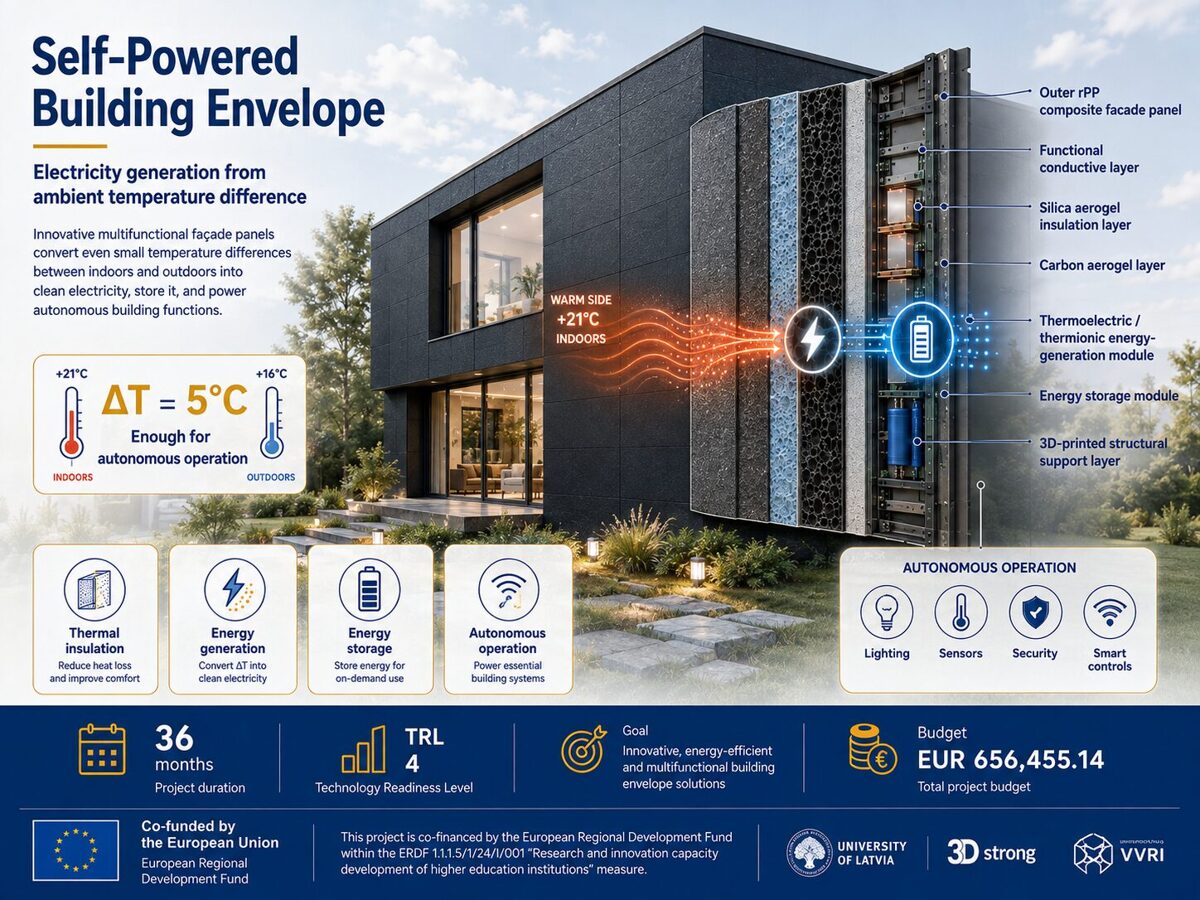
EnergySkin is developing a prototype multifunctional panel intended for future integration into energy-efficient building envelopes.
Unlike conventional insulation systems, the EnergySkin concept is designed to perform several functions simultaneously:
thermal insulation
thermal-to-electrical energy conversion
energy storage
structural integration
The project aims to demonstrate these functions in single-leg and multi-leg prototype configurations at TRL 4.
1. Aerogel-based thermal insulation
The EnergySkin system uses both silica aerogels and carbon aerogels.
Silica aerogel is a highly porous material characterized by extremely low thermal conductivity.
Within the EnergySkin concept, silica aerogel performs two important functions:
- thermal insulation
- nano-confinement of the polymer electrolyte
Carbon aerogels provide a combination of high porosity, electrical conductivity and electrochemical functionality and are being investigated as electrode materials for the integrated energy-storage system.
2. Thermoelectric / thermoionic energy generation
The EnergySkin concept is designed to harvest energy from relatively small temperature differences.
A specially developed polymer electrolyte contains mobile ions that respond to a temperature gradient.
When one side of the system is warmer than the other, ion movement can generate an electrical potential through thermodiffusion and thermogalvanic mechanisms.
The project targets operation with temperature differences relevant to building environments and low-grade thermal-energy sources.
3. Integrated energy storage
Instead of producing electricity and transferring it to a completely separate battery, EnergySkin investigates a system where generation and storage functions are integrated within the same device architecture.
The project develops an environmentally oriented all-solid-state sodium-ion concept using:
- carbon aerogel electrodes
- sodium-based polymer electrolyte
- silica aerogel
- solid-state layered architecture
The same system can also potentially accept energy from external renewable sources such as building-integrated photovoltaic systems.
4. Functional 3D-printed materials
Project partner 3D Strong Ltd is developing polymer composite materials for additive manufacturing of EnergySkin system components.
Two main material groups are being investigated.
Structural materials
Polypropylene and PET-based materials, including recycled polymers, are being developed for durable system housings.
Small additions of carbon nanotubes can be used to modify mechanical and functional properties.
Electrically conductive materials
Higher CNT concentrations are being investigated to create electrically conductive polymer composites suitable for future:
- contact electrodes
- embedded conductive structures
- current collectors
The materials are developed through melt compounding, granulation, extrusion and 3D-printing trials, followed by mechanical, thermal and electrical characterization.
5. 3D-printed system architecture
Project partner VVRI Ltd develops the CAD architecture and 3D-printed housings for the EnergySkin prototypes.
The project includes development of:
Single-leg prototype
A compact proof-of-concept unit containing one active element.
Multi-leg prototype
A larger system containing multiple active elements connected together.
The use of additive manufacturing makes it possible to modify geometry rapidly and integrate structural and electrically functional components into the housing.
Prototype development pathway
Materials → Components → Printing → Integration → Testing → Prototype
EnergySkin development includes:
- synthesis of carbon and silica aerogels
- development of thermoelectric polymer electrolytes
- electrochemical and thermoelectric characterization
- development of functional polymer composites
- CAD modelling and 3D printing
- prototype assembly
- thermal, electrical and electrochemical testing
The project will result in two prototype systems, six technological instructions and a Latvian patent application.
Technology status
EnergySkin is currently under research and development and is not yet a commercial construction product.
The current project aims to achieve TRL 4 — technology validated in a laboratory environment.