EnergySkin is an interdisciplinary research and technology-development initiative bringing together expertise in:
- nanomaterials
- polymer science
- electrochemistry
- thermoelectrics
- energy storage
- additive manufacturing
- 3D modelling
- advanced materials commercialization
The project was created around a simple question:
Can the building envelope become part of the building's energy system?
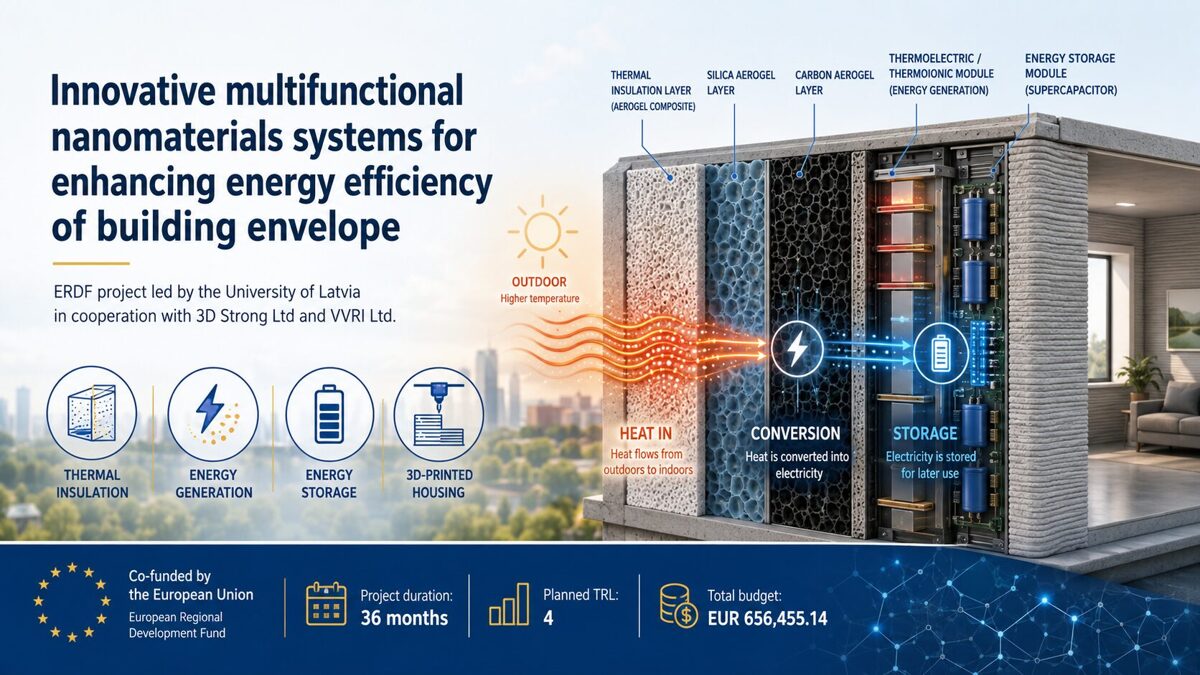
EnergySkin explores this possibility by combining advanced insulation, thermal-energy conversion and energy storage within one multifunctional material system.
Why we are developing EnergySkin
Buildings are among the largest energy consumers in Europe.
A significant share of the existing building stock is energy inefficient, creating a strong need for new approaches to insulation, energy generation and building modernization.
Most current building technologies address these challenges separately.
One material insulates.
Another technology generates energy.
A separate system stores it.
EnergySkin investigates whether these functions can be integrated into one multifunctional building-envelope technology.
Our Team
University of Latvia — Lead Partner
The University of Latvia leads the scientific development of the EnergySkin system.
Its responsibilities include:
- carbon aerogel development
- silica aerogel development
- polymer electrolyte development
- electrochemical characterization
- thermoelectric characterization
- integration and testing of the complete prototype
The research team brings extensive experience in nanostructured materials, thermoelectric systems, electrochemistry and advanced battery materials.
3D Strong Ltd — Functional Materials & 3D Printing
3D Strong develops the polymer composite materials required for manufacturing EnergySkin components.
The company's work includes:
- recycled and virgin polymer matrices
- CNT-modified polymer composites
- electrically conductive composites
- melt compounding
- extrusion
- filament and pellet-based processing
- mechanical characterization
- electrical characterization
- thermal characterization
- additive-manufacturing optimization
3D Strong brings expertise in carbon nanotube synthesis and advanced polymer composite development for 3D printing.
VVRI Ltd — Engineering & Additive Manufacturing
VVRI develops the engineering architecture of the prototype.
Its responsibilities include:
- 3D CAD modelling
- prototype housing design
- embedded electrode architecture
- current-collector design
- additive manufacturing
- optimization of single-leg and multi-leg structures
VVRI contributes expertise in industrially oriented additive-manufacturing systems and custom 3D-printing platforms.
Our approach
EnergySkin is developed through continuous collaboration between materials scientists, physicists, chemists and engineers.
Instead of developing each component independently, the project follows an iterative approach:
Develop → Test → Print → Measure → Optimize → Integrate
Material formulations are adjusted according to printing results.
Housing geometry is adapted according to material behaviour.
Electrode and electrolyte compositions are optimized according to electrochemical and thermoelectric performance.
This continuous feedback loop is central to the development of the final prototype.
Sustainability
Circularity is incorporated into the EnergySkin concept from the materials-development stage.
The project investigates the use of:
- recycled polypropylene
- recycled PET
- waste-derived carbon materials
- waste paper as carbon-aerogel precursor
- waste glass as silica-aerogel precursor
- abundant sodium-based materials
The aim is not only to improve building energy efficiency, but also to investigate material solutions that support a more sustainable and circular economy.
Our Vision
From passive walls to active energy systems.
Our long-term ambition is to develop building-envelope technologies that contribute actively to the energy performance of buildings.
EnergySkin represents a future in which the surface of a building can simultaneously:
protect it
insulate it
harvest energy
store energy
and support smart-building functions.